

The ‘Seniors First Downsizer Confidence Poll’ reveals growing demand by Over 55’s for alternatives to selling the family home
Downsizing has long been presented as an obvious solution for older Australians who need to release money from their home.
Sell the family home, purchase something smaller and use the remaining funds to support retirement.
In practice, however, the decision is rarely that simple.
New 2026 research from Seniors First suggests many older homeowners are interested in downsizing but are not necessarily ready—or willing—to sell in the current market.
Instead, a clear majority would prefer to remain in their current home and access some of its equity, provided the arrangement is suitable for their circumstances.
The Seniors First Over-55 Downsizing Confidence Poll received 193 responses, with almost all respondents aged 60 or older and 97.7% owning the home in which they live.
The findings provide an important insight into how older Australians are thinking about housing, retirement costs and financial flexibility. SBS world news recently featured the Seniors First poll in a news piece on the Austrralian Housing market.
Downsizing real estate remains relevant—but readiness is mixed
The survey found that downsizing is still very much on the minds of older homeowners.
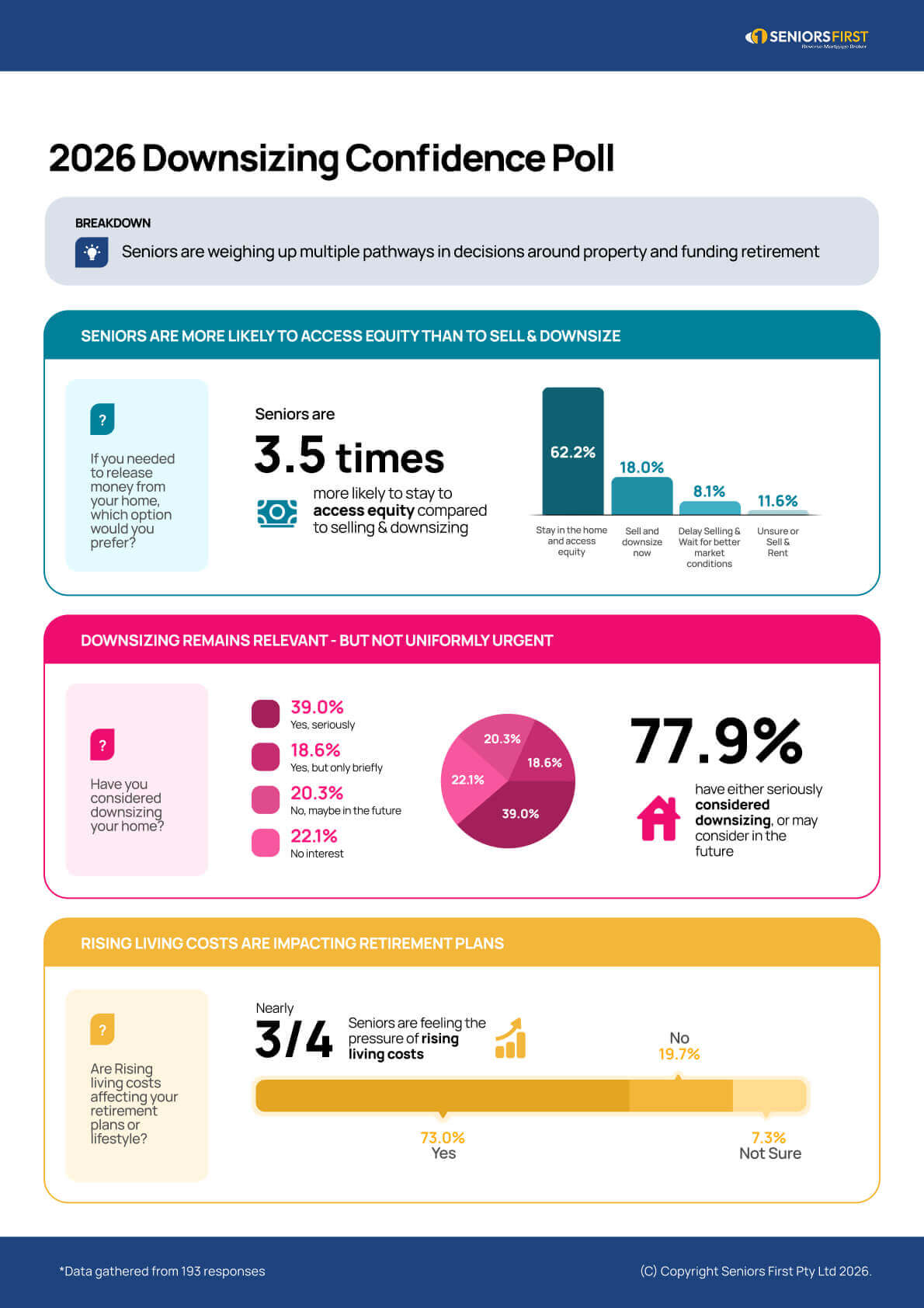
When asked whether they had seriously considered downsizing or selling during the past two years:
- 39% said they had seriously considered it.
- 18.6% said they had considered it briefly.
- 20.3% had not considered it yet but may do so in the future.
- 22.1% had no interest in downsizing.
Altogether, 77.9% of respondents had either considered downsizing or remained open to doing so in the future.
That is a significant level of interest. But it should not be mistaken for immediate readiness to put the home on the market.
For many older homeowners, downsizing is an option they are keeping in reserve rather than a decision they are ready to make today.
There can be emotional, financial and practical reasons for that hesitation.
The family home may hold decades of memories. It may be close to friends, family, doctors, shops and community services. The costs and disruption of moving can also feel overwhelming, particularly when the homeowner is uncertain about what price their property will achieve.
Property market uncertainty is delaying some decisions
Recent uncertainty in parts of the property market appears to be making some older homeowners more cautious about selling.
The poll found:
- 18.6% were now less likely to sell.
- 15.1% were delaying their plans to sell.
- 3.5% were more likely to sell before prices fell further.
- 52.9% said market conditions had not changed their plans.
- 9.9% were unsure.
In total, 33.7% of respondents said market conditions had either made them less likely to sell or caused them to delay their plans.
Only 3.5% felt encouraged to sell sooner.
This suggests that property market uncertainty is acting more as a brake than an accelerator.
Even among those who remain reasonably confident about selling, that confidence is not always strong.
While 66.3% said they were at least somewhat confident they could achieve the price they wanted, only 27.3% were very confident. Another 27.3% were either not very confident or not confident at all.
For a homeowner relying on the proceeds of a sale to fund the next stage of retirement, uncertainty about the final sale price can make a major life decision even harder.
Staying at home is the clear preference
The strongest finding from the poll came when respondents were asked what they would prefer to do if they needed to release money from their home.
Some 62.2% selected:
Stay in my home and access equity if suitable.
By comparison:
- 18% preferred to sell and downsize now.
- 8.1% preferred to delay selling until market conditions improved.
- 11% were unsure.
- Just 0.6% preferred to sell and rent.
The preference for remaining at home and accessing equity was more than three times as popular as selling and downsizing immediately.
This does not mean downsizing is the wrong choice.
For some people, moving to a smaller or more suitable property may reduce maintenance, bring them closer to family or improve access to health and community services.
However, the survey indicates that many older homeowners want to understand whether there is a less disruptive way to improve their financial position.
They want choice.
They may want to stay where they are for several more years, complete important repairs, create an emergency cash reserve or improve their day-to-day cash flow without being forced into an immediate sale.
Rising living costs are changing retirement plans
The poll also highlights the pressure that higher living costs are placing on retirees.
Some 73% of respondents said rising living costs were affecting their retirement plans or lifestyle either significantly or somewhat.
This is not simply a concern about the future. For many retirees, higher expenses are already affecting decisions about spending, home maintenance, travel, healthcare and financial security.
A homeowner may be living in a valuable property but still have limited money available each fortnight.
This is sometimes described as being asset-rich but cash-flow constrained.
The household may own most or all of its home, yet have difficulty covering larger expenses or maintaining the lifestyle it had expected in retirement.
Importantly, financial pressure does not automatically make someone ready to sell.
The survey suggests many older homeowners would first prefer to explore solutions that allow them to remain in familiar surroundings while improving their access to funds.
What would older homeowners use the money for?
Respondents were also asked what additional money released from their home might help them pay for.
The most common answer was home repairs or renovations, selected by 50.6% of respondents.
Other leading responses included:
- Everyday living costs: 44.2%.
- Travel or lifestyle expenses: 42.4%.
- An emergency cash buffer: 42.4%.
- A more suitable car: 25.6%.
- Repaying debt or an existing mortgage: 22.1%.
Respondents also identified medical and dental expenses, aged care planning, and in-home assistance as possible uses.
These findings show that accessing home equity is not necessarily about extravagant spending.
For many people, it is about practical needs: repairing the roof, replacing an unreliable car, paying for dental treatment, managing household bills or ensuring there is money available for an unexpected expense.
For others, it may be about enjoying retirement more fully by travelling, helping family or completing improvements that make the home safer and more comfortable.
The common thread is greater flexibility.
Strong interest in learning about reverse mortgages
When asked whether they would consider learning more about a reverse mortgage if they needed additional funds but did not want to sell:
- 25.6% said yes, definitely.
- 33.7% said yes, possibly.
- 18.6% were unsure.
- 14% said no.
- 8.1% already had a reverse mortgage.
This means 59.3% were positively open to learning more.
That result does not mean every respondent should take out a reverse mortgage. A reverse mortgage is a significant financial decision and will not be suitable for everyone.
It does, however, show that many older homeowners are looking for clear, trustworthy information about their options.
For people who are uncertain, education should come before any decision.
Questions worth considering include:
- How much money is actually needed?
- Would a lump sum, regular advance or cash reserve be more appropriate?
- How will interest affect the remaining home equity over time?
- Are there other ways to meet the same financial need?
- Could the decision affect future plans, family expectations or the estate?
- How long does the homeowner expect to remain in the property?
A carefully structured loan may also help avoid borrowing more money upfront than is necessary.
The goal should not simply be to access the largest amount available. It should be to understand the need, compare the available options and select an approach that supports both present-day comfort and longer-term financial security.
Why many people are delaying downsizing
The survey points to several factors that may be holding older homeowners back.
Market uncertainty is one. Some people worry that selling during a softer period could mean accepting less than they believe the property is worth.
Emotional readiness is another. Leaving a long-term home can involve much more than a financial calculation.
There are also substantial practical considerations, including preparing the property for sale, finding a suitable new home, paying moving and transaction costs, sorting through possessions and adjusting to a new community.
Finally, many homeowners simply prefer the alternative of remaining where they are.
For someone who is happy in their current home, downsizing may feel like an unnecessary sacrifice—particularly when their main objective is to improve cash flow rather than change where they live.
Downsizing and equity release are not mutually exclusive
Accessing home equity does not always mean abandoning the idea of downsizing forever.
For some homeowners, it may provide a temporary solution while they wait for a more appropriate time to sell.
For example, funds might be used to complete essential repairs, manage living costs or create a financial buffer for several years. The homeowner could then reconsider downsizing when market conditions, health needs or family circumstances change.
For others, staying in the home may remain the preferred long-term choice.
The important point is that older homeowners should not feel pressured into believing there is only one acceptable path.
Downsizing, remaining in place, using savings, accessing superannuation and releasing home equity all involve different benefits, costs and trade-offs.
The right decision depends on the individual.
Confidence, choice and control
The Seniors First poll reveals a mature and thoughtful audience.
Respondents are not rejecting downsizing altogether. Many remain open to it.
However, they are also cautious about selling in uncertain conditions and strongly attracted to options that allow them to remain in their home.
The clearest message is that older homeowners want confidence, choice and control.
They want to understand all the available options before making a decision that could affect their home, lifestyle and family.
For the 62.2% who said they would prefer to stay in their home and access equity if suitable, the next step is not necessarily to apply for a loan.
The next step is to become informed.
A specialist reverse mortgage broker can explain how equity release works, compare available lenders and structures, and help a homeowner consider whether it is appropriate for their circumstances.
At Seniors First, our focus is on helping older Australians make informed decisions about their home equity—without pressure and without unnecessary financial jargon.
Considering downsizing, but not sure you are ready to sell?
Speak with Seniors First to understand the alternatives that may be available. A conversation can help you compare downsizing with remaining in your home and accessing equity, so you can make a decision with greater clarity and confidence.
Survey note: The Seniors First Over-55 Downsizing Confidence Poll received 193 responses. The findings reflect the views of people who chose to participate and should be treated as directional audience insight rather than a representative study of all Australian homeowners aged over 55.

Can a RM be structured to allow for an initial lump withdrawal and later withdrawals and would interest be payable on the withdrawn or on the total RM.
Hi John, yes structuring reverse mortgage loans to minmise the lender interest cost is a big part of what we do. This is very possible, interest is only ever calculated on drawn amounts – not the total facility. See this page for more detail: https://seniorsfirst.com.au/about-us/why-choose-us/ Regards, Darren
This is a disgrace! The government wants us to use our houses for financial support, the houses we were paying off all our working lives for with after tax money! I would like to downsize, but the loss would be just too much…
1. Preparing the house for sale and moving is too hard for many older people
2. Paying selling expenses and stamp duty on the new purchase
3. Losing the pension and entitlements as there will maybe be left over amounts over the threshold
4. No certainty if the left over will be enough to support us to the end of life
5. And what about the legacy? We worked all our lives to leave something to our children, to help them… but we are not allowed to do so now or face losing the pension.
They are considering also to tax the inheritance, which is unheard of in most countries.
Any way I look at this, it is a total ripoff. What did we pay taxes for all our lives?
I wish to stay here as I have 2cats from RSPCA as kittens and over 55 retirement village unsuitable for them the house is flat had the changes made for safety on buying and you don’t get your money back in those villages they are a great ripoff
Your home should be asset free